Advancing Menstrual Health, Dignity and Climate-Resilient WASH Systems for the African Girl Child
Children’s rights are not meaningful simply because they are written into laws, policies and international commitments. They become meaningful when children can experience those rights in their everyday lives.
For millions of children across Africa, however, the gap between rights and reality remains wide.
A girl’s right to health, education, dignity, participation, water and sanitation can be undermined by something as basic as not having access to a safe toilet at school, clean water to wash with, affordable menstrual products, or accurate information about menstruation.
When climate change adds floods, droughts, water shortages and damage to already fragile infrastructure, these challenges become even more urgent.
This is why the conversation around children’s rights must also be a conversation about water, sanitation, menstrual health, climate resilience and dignity.
This October, Rise to Inspire Africa Initiative (RIA) joins partners and civil society organisations in Maseru, Lesotho, for an important regional conversation on how we can move from commitments on paper to meaningful change in the lives of African children, particularly girls.
From commitments to lived realities
The 29th CSO Forum on the Rights and Welfare of the Child will take place in Maseru under the theme:
“From Rights to Reality: Advancing Child-Sensitive, Climate-Resilient Water and Sanitation Systems to Achieve Agenda 2063.”
The theme speaks directly to one of the most important challenges facing children across the continent: ensuring that development systems are designed around their rights, realities and vulnerabilities.
Water and sanitation are often discussed as infrastructure or public health issues. But they are also fundamentally child rights issues.
A child cannot fully enjoy the right to health without access to safe water and sanitation.
A girl cannot participate equally in education when menstruation becomes a monthly barrier because she lacks access to appropriate facilities, products or information.
A community cannot be considered resilient when climate-related flooding or drought repeatedly destroys the water and sanitation systems children depend on.
And development cannot truly be inclusive when the voices and experiences of children, especially girls, are absent from the decisions that affect their lives.
Why menstrual health is a child rights issue
For many girls, menstruation is a normal biological process that can become a major social and economic challenge.
The problem is not menstruation itself. The problem is the systems and inequalities surrounding it.
When girls lack access to affordable menstrual products, private and safe toilets, water for washing, menstrual health information and supportive environments, menstruation can affect their ability to attend school, participate in community life and engage confidently in everyday activities.
Stigma and misinformation can make the experience even more difficult.
This is why menstrual health must not be treated as a standalone issue or simply as a matter of providing sanitary products.
It sits at the intersection of health, education, gender equality, WASH, social protection, climate resilience and human dignity.
A comprehensive approach must therefore address both the immediate needs of girls and the systems that create or reinforce the barriers they face.
No Girl Left Behind
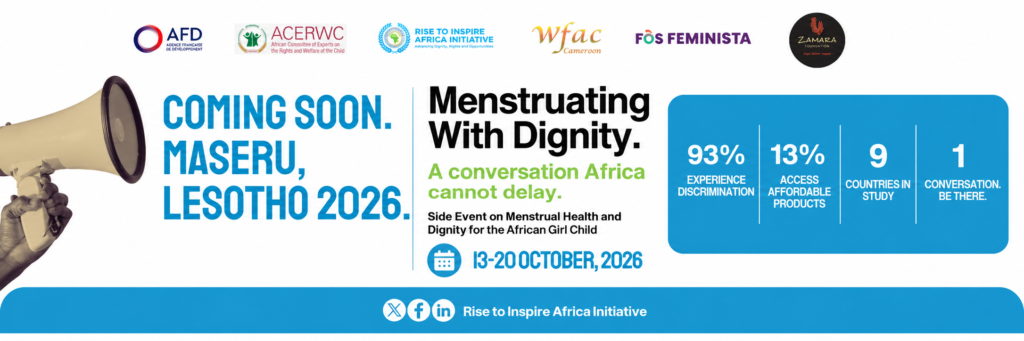
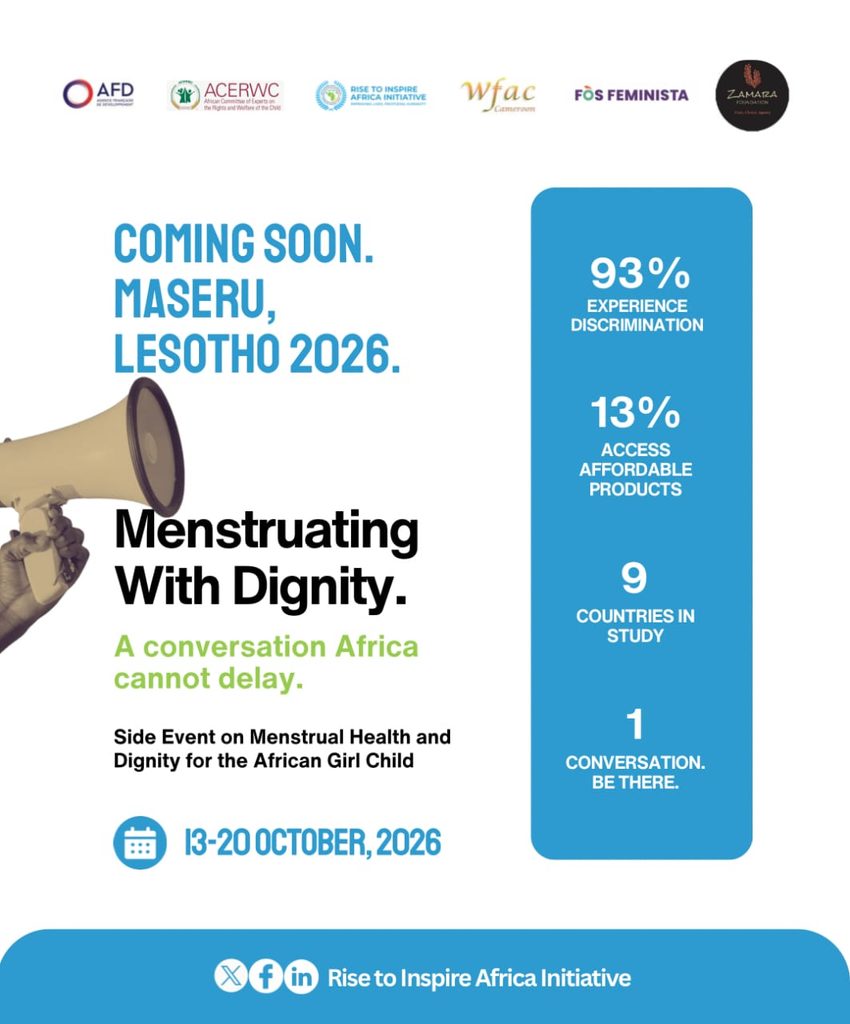
Against this backdrop, Rise to Inspire Africa Initiative, in collaboration with Women for a Change – Cameroon and Zamara Foundation Kenya, will host a side event focused on a critical question:
No Girl Left Behind: Menstrual Health and Dignity for Girls as WASH and Child Rights Imperatives in Africa
The side event will provide an opportunity to bring menstrual health and dignity firmly into conversations about child rights and WASH across Africa.
It will create space to examine the realities girls face and explore what it takes to build systems that are accessible, inclusive, climate-resilient and responsive to their needs.
The conversation will also recognise that girls should not only be seen as beneficiaries of policies and programmes. They are rights-holders and important voices in shaping the solutions that affect them.
Their experiences should inform policy.
Their voices should influence programmes.
Their needs should be reflected in budgets and infrastructure.
And their dignity should remain at the centre of development efforts.
The initiative is supported through the generous support of Agence Française de Développement (AFD) through Fos Feminista.
Climate change makes the challenge more urgent
The connection between climate change and WASH cannot be ignored.
Across many African communities, climate-related events can disrupt access to clean water and sanitation. Flooding can damage sanitation facilities and contaminate water sources, while drought and water scarcity can make basic hygiene increasingly difficult.
For girls and other vulnerable children, these disruptions can have consequences far beyond access to water.
A school without functioning sanitation facilities can become an unsafe or unsuitable environment.
A community experiencing water scarcity can make menstrual hygiene significantly more difficult.
A flood that destroys sanitation infrastructure can increase health risks while disrupting education and livelihoods.
This means that building child-sensitive WASH systems also requires building climate-resilient systems that can withstand, adapt to and recover from climate-related pressures.
The goal should not simply be to build more infrastructure.
It should be to build infrastructure and systems that remain accessible, safe, inclusive and functional when children need them most.
Connecting the conversation to Agenda 2063
Africa’s development aspirations cannot be separated from the rights and wellbeing of its children.
Agenda 2063 presents a vision of an inclusive and sustainable Africa where citizens can live with dignity and opportunity. Achieving that vision requires investment in the systems that shape children’s everyday experiences.
Safe water.
Adequate sanitation.
Accessible healthcare.
Quality education.
Gender equality.
Climate resilience.
Meaningful participation.
And protection from discrimination and exclusion.
These are not separate ambitions. They are interconnected.
When we invest in child-sensitive WASH systems, we are investing in health.
When we invest in menstrual health, we are investing in girls’ dignity and participation.
When we make infrastructure climate-resilient, we are protecting children’s access to essential services.
And when we listen to children and girls, we are strengthening the accountability of the systems designed to serve them.
From Maseru to meaningful action
The conversation in Maseru comes at an important moment.
The 29th CSO Forum on the Rights and Welfare of the Child will take place from 8–12 October 2026, followed by the 48th Ordinary Session of the African Committee of Experts on the Rights and Welfare of the Child (ACERWC) from 13–20 October 2026.
Together, these platforms provide an important opportunity for civil society, policymakers, child rights advocates, development actors and other stakeholders to reflect on what it will take to translate Africa’s commitments into tangible improvements in children’s lives.
For RIA, participation is grounded in a simple belief:
Rights must move beyond commitments and become reality.
It is not enough to say that every child has rights.
We must build systems that allow children to enjoy those rights.
It is not enough to speak about gender equality.
We must remove the barriers that prevent girls from participating fully in society.
It is not enough to talk about climate resilience.
We must ensure that the systems children depend on can withstand an increasingly changing climate.
And it is not enough to talk about menstrual health.
We must ensure that every girl can manage her menstruation safely, confidently and with dignity.
A call to action
The question before us is therefore not simply what rights do African children have?
The more important question is:
What are we doing to ensure those rights are experienced in reality?
Moving from rights to reality will require governments, civil society organisations, communities, development partners, schools, young people and other stakeholders to work together.
It will require stronger policies and implementation.
It will require investment in climate-resilient WASH infrastructure.
It will require better menstrual health education and access to affordable products.
It will require listening to girls and children themselves.
And above all, it will require us to stop treating dignity as an aspiration and start treating it as a standard.
Because no girl should have to choose between her dignity and her education.
No child should be left behind because the systems around them have failed.
And no commitment to children’s rights should remain only a commitment on paper.
From Maseru, Lesotho, the conversation continues.
From rights to reality.
From conversation to action.
From commitments to systems that work.
No Girl Left Behind.
📍 Maseru, Lesotho
📅 29th CSO Forum: 8–12 October 2026
📅 48th Ordinary Session of ACERWC: 13–20 October 2026
Rise to Inspire Africa Initiative
Advancing dignity, rights and meaningful change for Africa’s children and communities.
